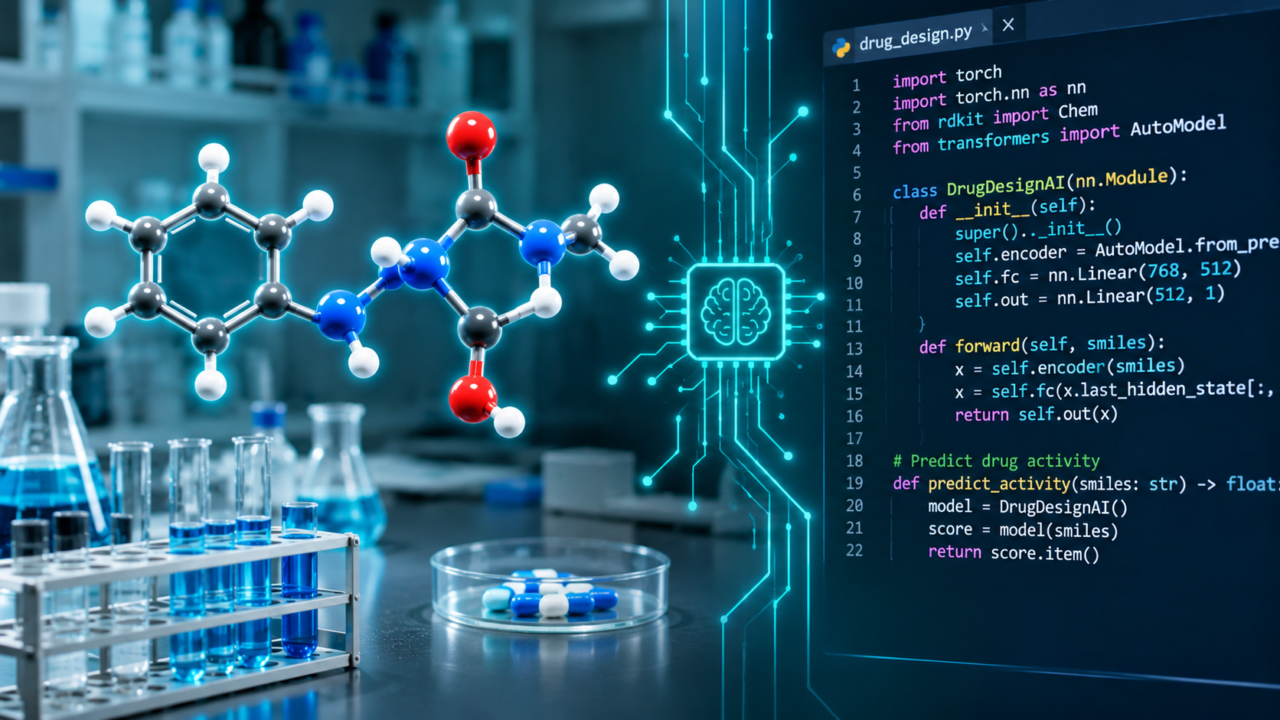
In September 2026, doctors in China gave the first patient a pill in a 320-person study of a lung-scarring drug. Insilico Medicine dosed that first patient on September 9 and describes the drug, rentosertib, as the first with both an AI-identified target and an AI-generated molecule to reach Phase III. On the other side of the tech world, a November survey of 1,026 developers found that AI now generates or significantly assists about 65% of the code they commit. chemdivsecurityboulevard
Medicine and software look nothing alike, yet AI is hitting both with the same result. It is very fast at making first drafts, and people still decide what is good enough. This article walks through each field and then looks at what they share.
AI in drug discovery
Why this field needs help
Making a new medicine is slow, costly and risky. It typically takes more than a decade and over $2 billion, and about 90% of drugs fail in clinical trials. Even small improvements in the early stages could save years and a lot of money. Fortune
How AI is used, step by step
Machine learning means software that learns patterns from data instead of following hand-written rules. Here is where it fits in drug discovery:
| Stage | What AI does | Real example |
|---|---|---|
| Finding a drug target (the protein or pathway a medicine should act on) | Scans biological data to rank promising targets | Insilico’s PandaOmics platform flagged a protein called TNIK as a fibrosis target. |
| Understanding proteins | Predicts a protein’s 3D shape from its sequence | AlphaFold, which predicts protein structures, shared a 2024 Nobel Prize in Chemistry. |
| Designing molecules | Generative AI (software that creates new content) proposes new drug-like molecules | Insilico’s Chemistry42 does generative design of candidate compounds. |
| Predicting how molecules behave | Estimates how a molecule binds to a target | Isomorphic Labs’ drug design engine, IsoDDE, was described in a February 2026 technical report. |
| Planning trials | Helps predict outcomes and match patients | Insilico uses its inClinico platform to predict and improve the trial outcomes of its program. Insilico’s rentosertib becomes first AI-discovered drug to enter Phase III +4 |
Real programs to know
Rentosertib (Insilico Medicine). This is the field’s flagship case, and the story has clear steps:
- AI picked the target and designed the molecule.
- A Phase IIa trial (an early test of whether a drug works) enrolled 71 patients across 22 sites in China for 12 weeks. allsci
- In the 60 mg arm, lung capacity improved by 98.4 mL on average at 12 weeks, while the placebo group declined by 20.3 mL. intuitionlabs
- The Phase III study plans 320 patients over 52 weeks. rentosertib
The Phase IIa study was small and short, so Phase III is the real test. It will show whether the signal holds in a larger group.
Other programs:
- Insilico’s second AI-designed molecule, ISM6331, received FDA Fast Track status on July 29, 2026 for a type of cancer called mesothelioma. Substack
- Exscientia’s DSP-1181 became the first AI-designed drug to reach clinical trials, in 2020. forklog
- Isomorphic Labs raised a $2.1 billion Series B round on May 12, 2026, and works with Eli Lilly and Novartis. The company has said it expects to file its first investigational new drug application and start human testing by the end of 2026. No human data exists yet. I found no confirmation that either step has happened. thepharmaletterthepharmaletter
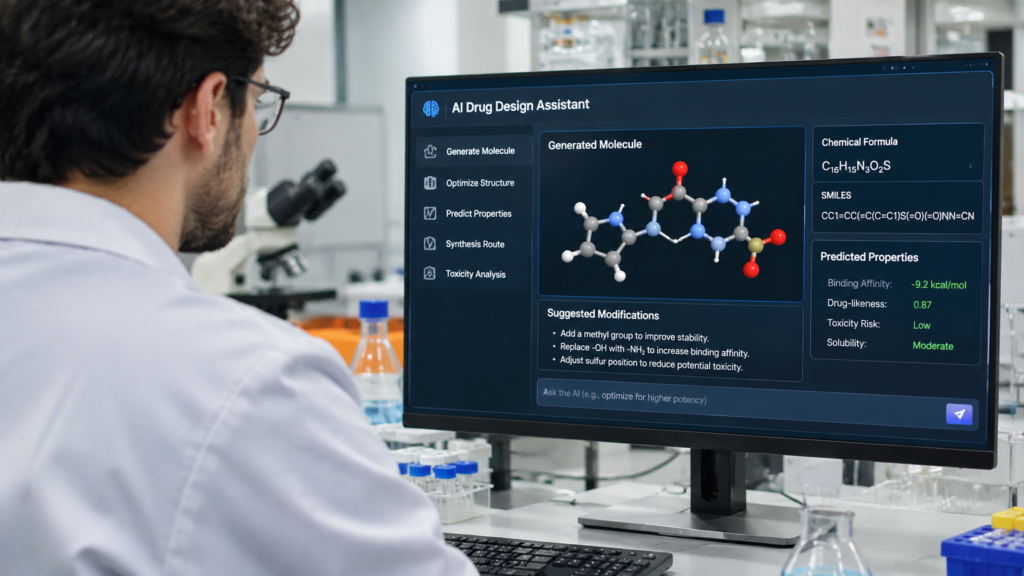
Is AI actually making drugs succeed more often?
The early numbers are encouraging but incomplete.
- Phase I tests safety. A 2024 analysis in Drug Discovery Today found AI-discovered molecules passed Phase I about 80–90% of the time. The older industry average is 40–65%. htworld
- Phase II tests whether the drug works. There the success rate was about 40%, roughly the same as traditional drugs, on a small sample. htworld
- A June 2026 Oliver Wyman analysis found AI-enabled programs advanced from Phase II about 45% of the time, against a 29% industry benchmark, but also called the Phase II sample limited. oliverwyman
AI looks good at designing molecules that are safe and behave well in the body. Proving that a drug treats disease is still the hard part.
What AI cannot do yet
- Replace trials. A Novartis research leader suggested AI could eventually shave about five years off discovery, but that human safety trials cannot be bypassed by algorithms. Fortune
- Win approval. No AI-discovered drug has yet been approved by a major regulator. lifesciencedaily
- Skip lab work. An Isomorphic Labs president has admitted that real wet-lab science is humbling when the software meets reality. Fortune
Be careful with labels. Takeda’s zasocitinib is sometimes called an “AI-designed pill,” and it is under FDA Priority Review with a decision expected in the first quarter of 2027. But it came from physics-based computer methods, not generative AI. intuitionlabs
AI in Software Engineering
From autocomplete to AI agents
AI coding has moved through stages. First came code completion (2020–2022), then chat assistants (2022–2024), and now agentic coding assistants. An agentic assistant is one that can read files, run commands and edit a codebase with little supervision. arxiv
Popular tools include GitHub Copilot, Cursor, Claude Code, OpenAI Codex and Google Antigravity. In Sonar’s survey, 85% of respondents had used Claude or Claude Code in the past year, up from 48%. Copilot use fell from 75% to 65%, and Cursor rose from 31% to 41%. That survey comes from Sonar, a code-quality vendor, so read the figures as industry signals rather than neutral measurements. secondtalentsecurityboulevard
What developers do with AI now
Developers use it to write code, find bugs, write tests, explain unfamiliar code and build rough prototypes in hours instead of weeks. 76% of respondents say their team uses AI tools on business-critical services. securityboulevard
The job itself is changing. 53% of developers now spend more time reviewing code than creating it, compared with 18% who said that before AI tools. That helps explain why engineers are spending more effort on: securityboulevard
- Code review: checking what the AI wrote.
- System architecture: deciding how the pieces fit together.
- Testing and security: proving the code is safe.
- Judgment: choosing what to build at all.
Is it really faster?
The honest answer is “it depends.” A 2025 randomized trial by the research group METR found experienced open-source developers took 19% longer with AI tools, even though they believed they were faster. That study covered 16 developers on large codebases they knew well, using early-2025 tools. In a February 2026 update, METR said it believes developers are likely sped up more now, but that wider AI adoption made its follow-up study too unreliable to produce a clear number. Treat claims of big speedups with some caution. They are plausible but not firmly proven. scienceblogmetr
Benefits versus risks
| Benefits | Risks |
|---|---|
| Faster prototypes and routine code | 76% of developers agree AI code is generated faster than it can be verified. |
| Help understanding large codebases | Only 6% fully agree AI code is functionally correct. |
| More time for design and problem-solving | The share who always check AI code before committing fell from 48% to 39%. |
| Better tests and bug detection | 44% are very or extremely concerned about new or subtle vulnerabilities. |
| Lower cost on repetitive work | Researchers have catalogued flaws in the coding tools themselves, such as command-injection and prompt-injection bugs. AI hit 65% of committed code a year early. Do we know what’s in the box? – Security Boulevard +4 |
Prompt injection means hiding instructions in text that an AI tool reads and then follows. Teams that check AI code while it is being written report better security outcomes than teams that check late, though the survey says this is an association rather than proof. The lesson is simple: more AI code means more need for human review. securityboulevard
The bigger picture
Both fields use AI the same way: to explore more options faster, then let experts choose. The key difference is how quickly you find out whether the AI was right.
| Drug discovery | Software engineering | |
|---|---|---|
| What AI produces | Targets, molecules, predictions | Code, tests, fixes |
| How fast you learn if it works | Years (trials) | Minutes to days (tests) |
| Cost of a mistake | Patient safety, huge expense | Bugs, security breaches |
| Final gatekeeper | Regulators and clinical trials | Reviewers, tests, security teams |
| Human role | Scientists, doctors, trial designers | Architects, reviewers, security engineers |
| Maturity | No approved drug yet | Mainstream daily use |
My reading of this is analysis, not a forecast. Software gets the fastest gains because its feedback loop is short. Medicine will move more slowly because a drug can only be judged in people, over time. In both fields the scarce skill is shifting from producing a first draft to judging it.
Conclusion
AI has not replaced scientists or programmers, and the 2026 evidence suggests it won’t soon. It has made experts faster at asking questions and trying ideas, and it has made their judgment more valuable. The test to watch is rentosertib’s Phase III readout. A win would be the first placebo-controlled proof that an AI-found target and molecule can work in patients.
Sources
- Insilico Initiates Phase III Clinical Trial for Rentosertib – PR Newswire (Jul 7, 2026)
- Insilico Doses First Patient in GENESIS-IPF-3 – PR Newswire (Sep 9, 2026)
- A generative AI-discovered TNIK inhibitor for IPF: Phase 2a trial – Nature Medicine (via PubMed Central)
- Insilico’s rentosertib becomes first AI-discovered drug to enter Phase III – AllSci (Sep 10, 2026)
- Rentosertib: from AI hypothesis to Phase III – rentosertib.net
- Isomorphic Labs profile – The Pharma Letter
- Big pharma, venture capital and Hassabis bet on AI drugs – Fortune (Jan 23, 2026)
- Clinical potential of AI in drug discovery (Drug Discovery Today analysis summary) – HealthManagement.org
- Biopharma’s AI investment brings results and new challenges – Oliver Wyman (Oct 2026)
- AI-Discovered Drugs in 2026: The State of Play – Life Science Daily
- AI Drug Discovery FDA Approvals: The 2026 Reality Check – IntuitionLabs
- Insilico pipeline summary – ForkLog (Exscientia, Recursion, Isomorphic)
- State of Code Developer Survey 2027 – Sonar (via Security Boulevard, Nov 12, 2026)
- We are Changing our Developer Productivity Experiment Design – METR (Feb 24, 2026)
- AI coding tools may not speed up every developer – TechCrunch (Jul 2025)
- AI Coding Assistants as Attack Surface – Cloud Security Alliance
- Prompt Injection Attacks on Agentic Coding Assistants – arXiv