Mid-November, one week. Washington moved to close a loophole that let Chinese companies rent American AI chips through data centers abroad. The Trump administration issued new rules on Monday restricting remote access to advanced US computing chips and servers. Days earlier, Nvidia’s CEO Jensen Huang had resigned. Then the Nasdaq plunged 5.28% on Friday, wiping out its gains for the year. trump administration moves close ai chip loophole before china trip +2
Behind the headlines sits a bigger question. The next global superpower may be decided less by tanks or GDP than by who builds, controls and deploys the most capable AI. And the numbers send mixed signals. US data centers hold nearly 40 times the computing power of China’s, yet analysts estimate the best US models lead by only six to nine months. lowyinstitute
So is America still leading the AI race, or is China catching up faster than anyone expected? The honest answer is both, depending on what you measure.
The Short Answer
- America leads in the smartest frontier models, advanced chips, private capital and everyday AI use.
- China leads in open-source AI, factory and humanoid robots, electricity supply and research volume.
- The model gap is months, not years. The chip gap is the widest and hardest to close.
- There is no single winner. There are several races running at once.
US vs China AI: The Scoreboard
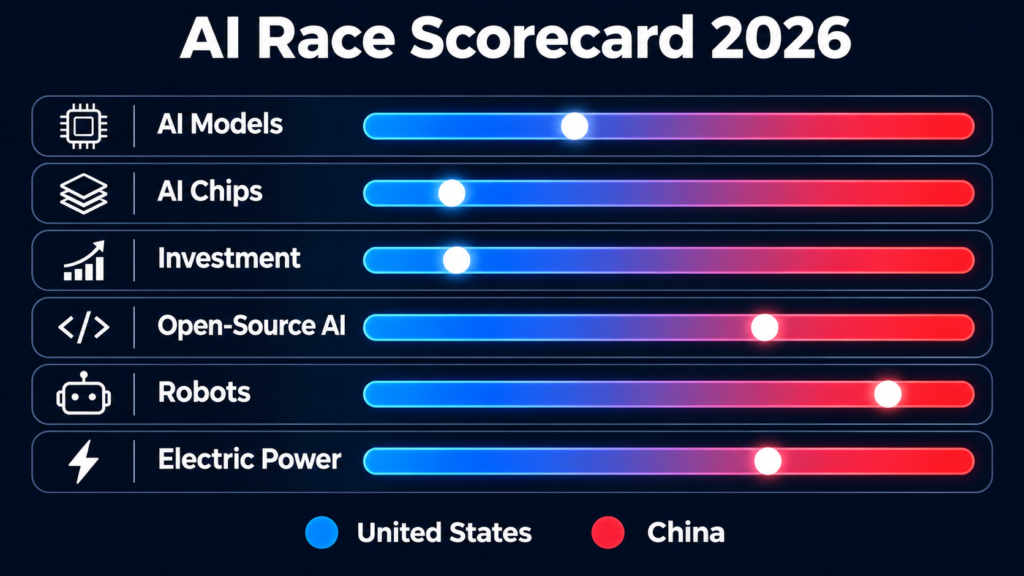
| AI Category | United States | China |
|---|---|---|
| Frontier models | Google’s Gemini 4 Carbon leads the Arena ranking (about 1528); Anthropic’s Claude Opus 5.5 scores about 1509 | Moonshot’s Kimi K3 is the top Chinese model (about 1488, ranked 19th); Alibaba’s Qwen3.8-Max and DeepSeek V4 follow |
| Open-weight models | About 500 million Hugging Face downloads in Q3 2026 | About 1.8 billion downloads, 78% of the two countries’ combined total |
| AI chips | Nvidia holds over 60% of AI computing capacity among major chip designers | Huawei’s Ascend line is growing fast but makes under 4% of Nvidia’s AI compute in 2026 |
| Computing power | About three-quarters of world AI compute; 5,400+ data centers | Just over 14% of world AI compute |
| Investment | $285.9B private AI investment (2025); about $764B hyperscaler spending in 2026 | $12.4B private investment, plus state funds; about $102B big-tech spending in 2026 |
| Electricity | Grid and permitting limits slow new data centers | Generates over twice the US’s electricity and is adding capacity faster |
| Robotics | Atlas robots committed to Hyundai; Tesla’s Optimus not yet in productive factory use (as of Q1 2026) | 59% of new industrial robots in 2025; over 80% of humanoid installs |
| Research | 50 notable models in 2025; top talent magnet | 30 notable models; 27% of AI publications vs 12% for the US |
| Government strategy | Market-led, chip export controls, “Pax Silica” supply-chain bloc | 15th Five-Year Plan, “AI Plus” push, “WAICO” governance group |
| Everyday use | Over 90% of web traffic and 80% of app use between the two countries’ models | 55% of text requests on OpenRouter (late October) |
Round 1: AI Models, Where the Gap Is Months, Not Years
Start with the part everyone watches: whose AI is smartest. On Arena, a site where people vote blindly between two chatbot answers, Google’s Gemini 4 Carbon leads in November, with Gemini 4 Argon and Anthropic’s Claude Opus 5.5 close behind. China’s best, Kimi K3, ranks 19th. lowyinstitute
But rankings are slippery. When Kimi K3 launched on July 16, independent firm Artificial Analysis placed it third on its Intelligence Index, a combined score from many tests. Different scoreboards tell different stories. Stanford’s 2026 AI Index, the most-cited review, concluded that US and Chinese models have traded the lead multiple times since early 2025. The gap fell to about 2.7% in March 2026, down from 17.5 to 31.6 points in May 2023. In May, the US government’s CAISI estimated DeepSeek V4 Pro was about eight months behind leading US models. July 17, 2026 +3
China also competes on price. Artificial Analysis estimated that running its test tasks cost about $0.04 with DeepSeek V4 Pro versus $1.80 with Claude Opus 4.8. And Alibaba’s Qwen3.8-Max became the highest-ranked Chinese text model on Arena at launch, though it still trailed Claude Fable 5 and three Opus variants. the-decoderdailysabah
Round 2: Chips and Computing Power, America’s Biggest Lead
Compute means the total calculations all of a country’s AI chips can perform each second. Epoch AI estimates the US holds nearly three-quarters of the world’s AI computing power and China just over 14%. US AI chips outnumber China’s in power by 31 times. Al Jazeeralowyinstitute
China is working hard to close it. Huawei expects about $12 billion in AI chip revenue in 2026, up from $7.5 billion last year. Still, Epoch AI estimates Huawei will make less than 4% as much AI compute as Nvidia in 2026. A key bottleneck is HBM, high-bandwidth memory, the fast memory stacked beside an AI chip. China’s main memory maker was still ramping up and could not yet support hundreds of thousands of Ascend chips at the start of 2026. huawei expects 12 billion in ai chip revenue this year as nvidias china market share hits zero +2
Chinese labs are shifting anyway. DeepSeek plans to use Huawei’s Ascend 950 chips to train its next model, V5, targeted for 2027. Other large Chinese firms still depend heavily on Nvidia’s CUDA software, the toolkit most AI developers build on. business-standard
The workaround that worries Washington is renting chips remotely. The Institute for Progress estimates remote access could supply a quarter of China’s AI computing capacity by the end of 2026. The new US rule requires export licences for advanced chips going to Singapore, Thailand, Malaysia, Indonesia and Brazil. It came days after Huang resigned amid scrutiny of his ties to a Chinese executive formerly of Megaspeed, a firm suspected of diverting Nvidia chips to China. Beijing called the rule economic coercion and said it would take necessary measures. US moves to restrict China’s remote access to AI chips after Nvidia row +3
Round 3: Money and Electricity, Dollars vs Watts
America wins on spending. Goldman Sachs expects US hyperscalers, the giant cloud companies, to spend about $764 billion in 2026 versus about $102 billion for Alibaba, Tencent, Baidu and ByteDance. Stanford counts $285.9 billion of US private AI investment in 2025, 23 times China’s $12.4 billion, though that likely understates China’s total spending. Government guidance funds put an estimated $184 billion into Chinese AI firms between 2000 and 2023. China vs US: Who is winning the AI race, in four charts +2
But a money lead depends on investors keeping faith. This week’s rout in Nvidia and other AI stocks shows how quickly that faith can wobble. foxbusiness
Then there is electricity, which may matter more than many realize. China already generates more than twice as much electricity as the US, and BloombergNEF expects it to add over six times as much capacity in the next five years. Wood Mackenzie said US grid limits contributed to a 50% quarter-on-quarter drop in new data center projects at the end of 2025. In short, America has the chips but is short on power, and China has the power but is short on chips. Each is racing to fix its weak spot. Al JazeeraAl Jazeera
Round 4: Open-Source AI, China’s Secret Weapon
Open-weight models are AI systems whose trained files anyone can download and run on their own computers. China has bet big on them. In Q3 2026, Chinese models were downloaded nearly 1.8 billion times on Hugging Face versus 500 million for US models. On OpenRouter, a platform where developers access many models, Chinese models took 55% of text requests in late October versus 38% for US models. Governments and businesses like them because they can run them on their own servers to keep data local. lowyinstitutelowyinstitute
Yet the consumer picture flips. US models drew over 90% of web traffic and over 80% of app use between the two countries’ AI products. Put simply, China is winning among builders and the US is winning among everyday users. lowyinstitute
This is now a political fight too. US policymakers have discussed restricting Chinese open-weight models since Kimi K3’s launch. In October, China proposed adding 40 technologies, including 23 related to AI, to its own export restrictions. business-standardlowyinstitute
Round 5: Robots and Physical AI
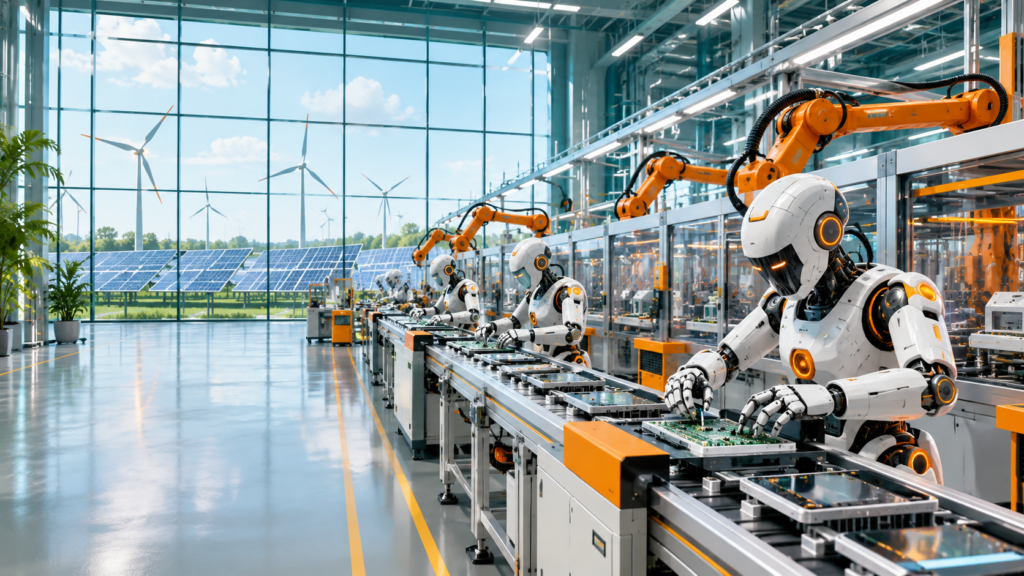
Physical AI is AI that controls machines in the real world. The International Federation of Robotics counted a record 603,000 new industrial robots in 2025, and 59% went to China. Counterpoint estimates about 16,000 humanoid robots were installed worldwide in 2025, almost 13,000 of them in China. scmptomshardware
The US is strong on design and ambition but behind on volume. Boston Dynamics has begun commercial production of its electric Atlas, with every 2026 unit committed to Hyundai, while Tesla’s Optimus had no productive factory deployments as of early 2026. thenextweb
Round 6: Research, Talent and Government Strategy
Stanford found China leads in publication volume, citations and industrial robotics, while the US leads in top-model development and investment. China produced over 27% of global AI publications in 2024 versus 12% for the US, though that count covers English-titled work only. Talent is a twist. MacroPolo found 47% of the world’s top AI researchers did their undergraduate studies in China, yet 72% of China-educated top researchers worked in the US. Stanford’s AI Index 2026 shows rapid progress, growing safety concerns, and declining public trust +2
The two governments play very different games. The US relies on private companies plus chip controls and alliances. It launched Pax Silica, a 24-member AI supply-chain framework, in December 2025. China plans centrally. Its 15th Five-Year Plan mentions AI 52 times, five times more than five years earlier, and gives computing power its own chapter. The “AI Plus” initiative targets AI integration across 90% of the economy by 2030. Beijing also launched WAICO, an AI governance group, in July, with 29 founding signatories. Asia Power Snapshot: China, the United States, and the race for AI dominance +3
Why This Race Matters Beyond Two Countries
- Prices and access: Cheap, open Chinese models lower costs for startups and for governments in developing countries, and they challenge pricing from US labs.
- Jobs and productivity: The effects are still uncertain. Stanford’s latest findings describe an uneven picture of labor-market outcomes. stanford
- Security: The US has proposed an AI “notification mechanism” with China, a hotline to alert each other when AI incidents threaten national security. Al Jazeera
- Everyone else: Neither superpower is widely trusted to regulate AI, and no Asian country has joined both rival blocs. Middle powers are being forced to pick sides, or try to bridge them. lowyinstitute
So, Who Is Winning the AI Race Right Now?
A 14-indicator analysis by the Lowy Institute found the US currently leading, though unevenly. Our reading of the evidence: lowyinstitute
- The US leads where it matters most today: the smartest models, the best chips, the deepest pockets and the biggest user base.
- China is closing fast on models, and the gap there is months. It already leads in open-source reach, robots, electricity and research output.
- Chips remain the key divide. If US export controls hold and China’s chipmakers stay supply-limited, America keeps its edge. If China’s workarounds, such as remote access and homegrown Huawei chips, succeed, that edge shrinks.
- The US money advantage is not guaranteed. It depends on investor confidence, which was shaken this week.
There will likely be no single winner across every layer. America is ahead in building the most powerful AI. China is ahead in making AI cheap, open and widely deployed.
What to Watch Next
Scheduled or reported (facts):
- DeepSeek’s V5 model, planned on Huawei’s Ascend 950, is targeted for 2027. business-standard
- Huawei’s Ascend 950, 960 and 970 chips are slated for phased rollout through 2028. gulfnews
- US Senate bills would let Congress review chip licenses, track chips, and press allies such as the Netherlands and Japan to match US restrictions. The Boston Globe
FAQs
Is China ahead of the US in AI? Not overall. The US leads in frontier models, chips, funding and everyday use, while China leads in open-source AI, robotics and electricity.
Who has better AI chips? The US, through Nvidia. Huawei is improving but produces under 4% of Nvidia’s AI compute in 2026.
Why are Chinese AI models so popular? They are cheap, often open to download, and can be run privately, which appeals to developers and governments.
Sources
Reuters via NST: Wall Street ends lower as Nvidia CEO resigns
Lowy Institute: Asia Power Snapshot, China, the US and the race for AI dominance (Nov 2026)
Al Jazeera: China vs US, who is winning the AI race, in four charts
Stanford HAI: 2026 AI Index Report and Economy chapter
TNW: Stanford AI Index finds China nearly closed the performance gap
The Decoder: Stanford’s AI Index 2026
Business Standard: US moves to restrict China’s remote access to AI chips
AP via Boston Globe: Trump administration moves to close AI chip loophole
AP via Jamaica Gleaner: New rules to block China’s indirect access to US AI technology
Tom’s Hardware: Huawei expects $12 billion in AI chip revenue
Epoch AI: Huawei’s roadmap to 2031
Gulf News (Bloomberg): Huawei to double output of AI chip
Artificial Analysis: Kimi K3 ranks #3 on the Intelligence Index
The Decoder: Kimi K3 and the end of super-cheap Chinese AI
Daily Sabah: Alibaba unveils Qwen3.8-Max as DeepSeek sets new low-cost benchmark
Al Jazeera: China’s secret weapon in the AI race, lots of cheap energy
IFR: World Robotics 2026, China installs 59% of the world’s industrial robots and TNW coverage
Tom’s Hardware: Robotics and world models, China ahead with 13,000 humanoid robots
TNW: Unitree, Atlas and Optimus comparison
Axios: Inside China’s mind on AI
SCMP: China’s five-year plan and the AI Plus target
Fox Business (with Reuters): Wall Street suffers historic losses