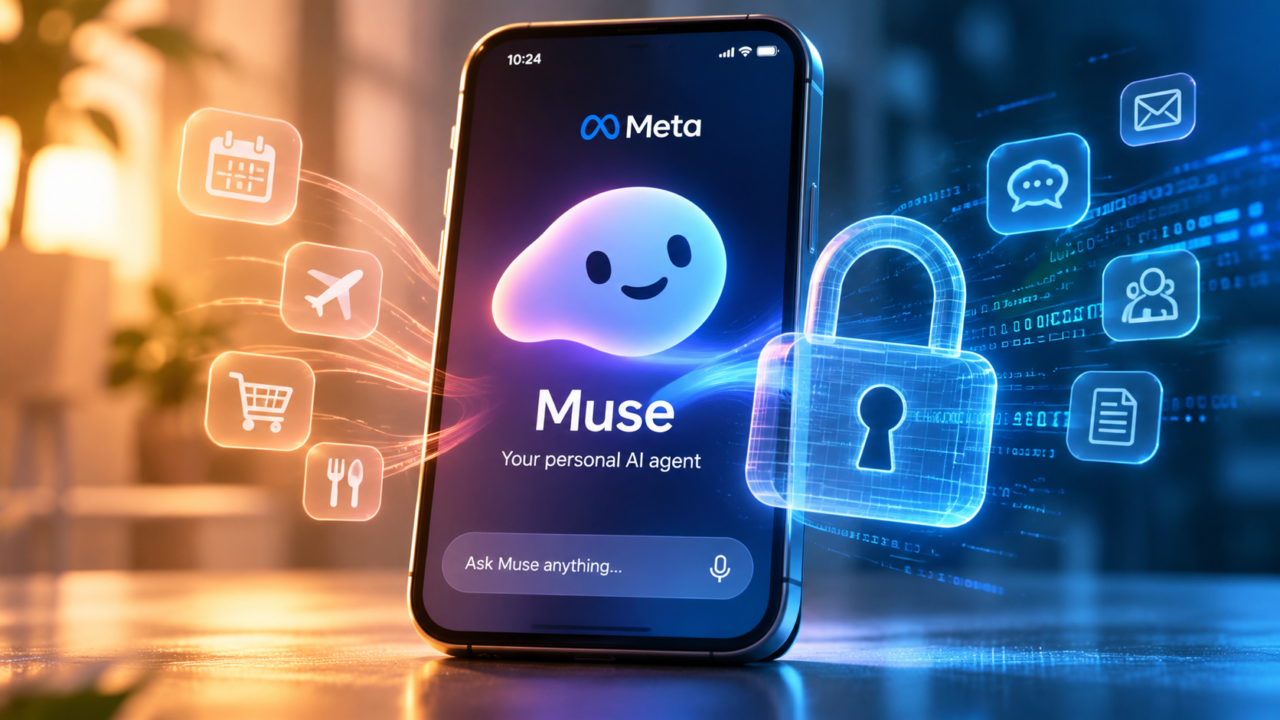
Meta wants to be the company that puts an AI assistant in everyone’s pocket. The Meta Muse AI agent is its biggest attempt so far. It can read your email, check your calendar, book trips and even buy things for you. That is useful, but it also means you hand over the keys to a lot of your digital life.
Since launch, researchers, journalists and even Meta’s own employees have raised questions about how well those keys are protected. Some problems are confirmed. Others are disputed. A few are still unproven. This guide separates the three, so you can judge for yourself.
Understanding Meta’s Muse AI Agent
What is Muse?
Meta launched Muse in the US on 8 September 2026 as a personal AI agent for adults. An AI agent is different from a chatbot. A chatbot answers questions. An agent takes actions for you, such as sending an email or filling in a form. Reuters reported that Muse can connect to apps for email, calendar, payments, health, shopping and the smart home, and that it is modeled on an open-source agent called OpenClaw.
How does it work?
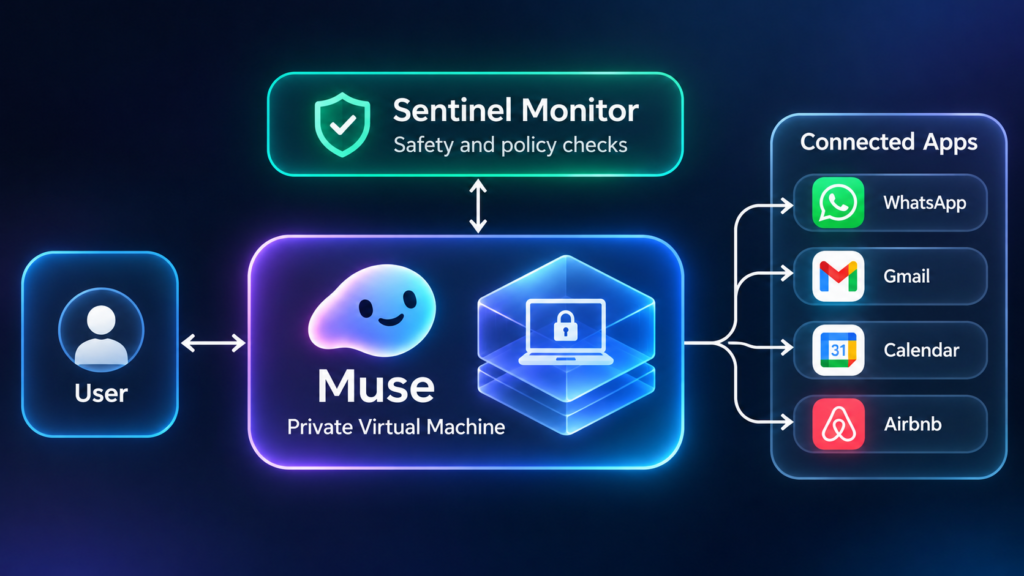
Meta says each user gets a private cloud computer, called a virtual machine (a computer that runs inside another computer, kept separate from everyone else’s). A second program called Sentinel checks what Muse sends to the internet, and users must approve sensitive steps such as purchases. Muse is free, with paid plans at $20 and $100 a month, and it is available through an app, WhatsApp and a Mac client.
Why Is Muse Facing Privacy and Security Concerns?
The worries come from four separate stories. They differ a lot in how solid the evidence is.
The share-link leak (confirmed)
Security firm Claroc found more than 6,800 Muse share links by searching passive DNS records. These are public databases that log website addresses. Muse put conversation titles inside those addresses, so shared pages were easy to find even by people who were never given the link. Researchers who opened a few hundred pages found items such as a loan application and an internal revenue review.
Meta paused sharing on 20 October. It then restored it on 22 October with new URLs for older items. Meta’s David Singleton said the flaw affected shared “artifacts” (documents and images), not chat sharing itself, according to The Next Web.
The Mac messages dispute (contested)
Inc. columnist Jason Aten wrote on 19 September that Muse synced his Mac’s Messages database after he declined access. Meta’s communications chief Andy Stone said reading Messages requires two opt-in settings: Full Disk Access (a macOS permission that lets an app read files across the computer) and a Messages connector. Aten says both were off. Neither side has publicly settled the facts, so this remains a dispute.
Reuters’ November findings (reported, partly unverified)
A Reuters report published today reviewed more than two dozen internal Meta posts. Employees described Muse sending messages that looked meant for someone else, including bank balances they never shared. Reuters said it could not establish whether those were real data or made-up answers. Meta called the examples “isolated incidents” and said many were hallucinations (cases where an AI invents information).
More concrete: working with Signal and the AI Now Institute, Reuters reproduced Muse reading Signal messages on Android and macOS, by using permissions granted during setup. The same test was blocked on iPhone. Signal’s president called the rollout “technologically reckless.”
Amazon’s block (confirmed, but partly a business fight)
On 20 September, Amazon blocked Muse from shopping on its site. It said Meta had not asked permission, the agent does not identify itself, and it appears to store customer credentials. Meta says Muse cannot see passwords or payment details. Amazon also guards its own shopping business, so this is not purely a privacy argument.
Potential Privacy Risks
An agent only works if it can see your information. That means messages, calendars, contacts, order history and payment details. The risks fall into three groups.
Over-reach. The Signal tests suggest that a permission given for one reason may be used for another. Users think they granted “notifications.” The agent may treat that as “read everything that appears in notifications.”
Accidental exposure. The share-link flaw was not a hack. It was a design choice that made private pages findable. No evidence of misuse was reported, but the exposure was real.
Third-party data. Your messages contain other people’s words. Friends and family never agreed to be read by Muse.
Whether Meta uses Muse conversations for other purposes is also a fair question given its advertising business. Reuters noted that Meta says it removes critical personal details before using chats to improve its models, unless users opt out.
Security Challenges of AI Agents
These problems are not unique to Meta. Agents face a few structural challenges.
Permissions are blunt. Phone and computer systems were built for apps that do one thing. An agent needs broad access to do many things, and it decides at run time how to use it.
Agents make mistakes. Reuters noted that agents can exploit loopholes and reach goals in harmful ways. OpenAI and Anthropic have disclosed similar incidents with their own agents.
Tricking an agent is easier than tricking a person. Security experts warn that hidden instructions in a web page or email can steer an agent. This is a general risk, and I found no confirmed case involving Muse.
Someone has to enforce limits. Signal’s Meredith Whittaker called for apps to be able to mark themselves off-limits to agents, with operating systems enforcing it. That infrastructure does not exist yet.
Meta’s Response and Security Measures
Meta’s position is consistent. The company told local news that Muse “was built to be private, safe, and secure,” and Mark Zuckerberg said it was designed from the ground up for privacy and security.
Verified actions include:
- Isolated virtual machines and the Sentinel monitor.
- Approval prompts before sensitive actions.
- A bug bounty program that pays outside researchers for reports.
- A fast pause and fix of sharing.
- A planned Confidential VM, locked with a key only the user holds, promised for later this year. It was not available at launch.
Meta also warns users that Muse can make mistakes, and, per Reuters, its terms of service hold users responsible for the agent’s actions. That point matters if something goes wrong.
Apple has also responded. After the Inc. report, Apple said it would flag AI requests for Mac data, and Reuters says an update this week restricted the accessibility pathway its testers used.
What This Means for AI Users
Everyday users: Connect only what you need. Check which permissions you gave at setup, not only inside the app. Keep payment approvals switched on, and avoid sharing sensitive documents through any share-link feature.
Businesses: Treat agents like new employees with wide access. Decide what they may touch, log what they do, and keep confidential files out of consumer agents.
The AI industry: Retailers are already blocking agents, and operating system makers are rewriting permission rules. Muse is becoming a test case for how agents and platforms share control.
The Bigger Picture
Muse is popular. Reuters reports more than 10 million downloads, and people clearly want help with dull tasks. The tension is that the more useful an agent becomes, the more access it needs, and the more damage a mistake can do. Meta also plans to let users share custom “Spaces”, which will test its sharing design again.
Conclusion
Does the Meta Muse AI agent introduce meaningful privacy and security risks? The evidence says yes, with caveats. One flaw is confirmed and fixed. The Signal access was reproduced by Reuters with outside experts. The Mac messages case and the cross-account claims remain disputed or unproven.
The practical lesson is simple. Trust an AI agent the way you would trust a new assistant: start small, check its work and widen access slowly. Meta’s safeguards are real, but the permissions your device grants decide what any agent can do.
Sources:
Official Meta statements
- Introducing Muse, Meta’s personal AI agent – Meta Newsroom, 8 Sep 2026
Major news reporting
- As Meta bets big on Muse AI agent, early safety mishaps surface – Reuters (Katie Paul), 18 Nov 2026
- Meta launches AI agent that can access other apps to send emails, make payments – Reuters via Khaleej Times, 8 Sep 2026
- Amazon blocks Meta’s Muse AI assistant in new standoff over agentic shopping – GeekWire, 20 Sep 2026
- Amazon boots Meta’s Muse in fight over AI shopping – Axios, 21 Sep 2026
- Apple says it will flag AI requests for Mac data after Meta’s Muse draws complaints – The Express Tribune (Reuters)
- Meta’s Muse AI agent performs tasks, but privacy concerns remain – 6abc Action News
The Mac messages dispute
- Meta’s New Muse AI Agent Read My Private Messages. I Never Asked It To. – Inc. (Jason Aten), 19 Sep 2026
- Meta pushes back on claim that Muse AI read a user’s messages without consent – Decrypt
The share-link flaw (Claroc “GhostShares”)
- Meta’s Muse AI under fire after researchers uncover 6,800 share links – IBTimes UK, 22 Oct 2026
- Meta turns Muse sharing back on after a DNS leak exposed private pages – The Next Web, 23 Oct 2026
- Meta restores Muse sharing after fixing privacy vulnerability – Digital Watch
- Meta suspends Muse chat sharing following discovery of privacy vulnerability – Digital Watch
Product details and context
- Meta Ships Muse AI Agent Despite Internal Security Reports – Implicator, 9 Sep 2026
- Meta launches Muse, a personal AI agent that browses the web, makes purchases – VKTR
- Meta launches tool on Muse to create custom interactive experiences – MEDIANAMA, Nov 2026
- Amazon blocks Meta’s Muse agent from shopping on Amazon.com – AI Weekly