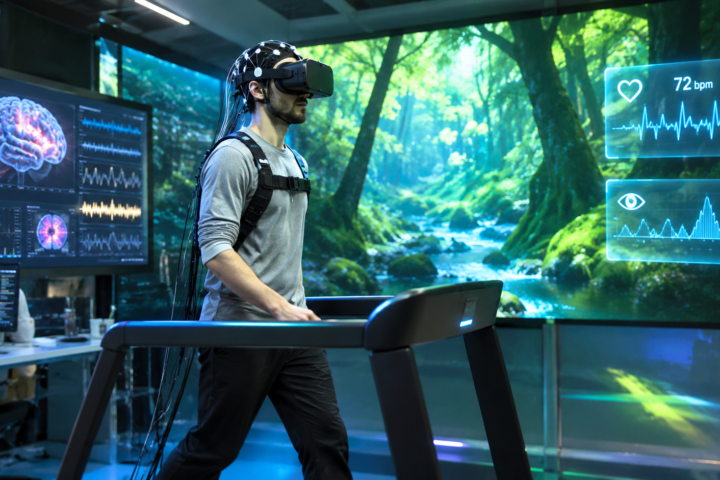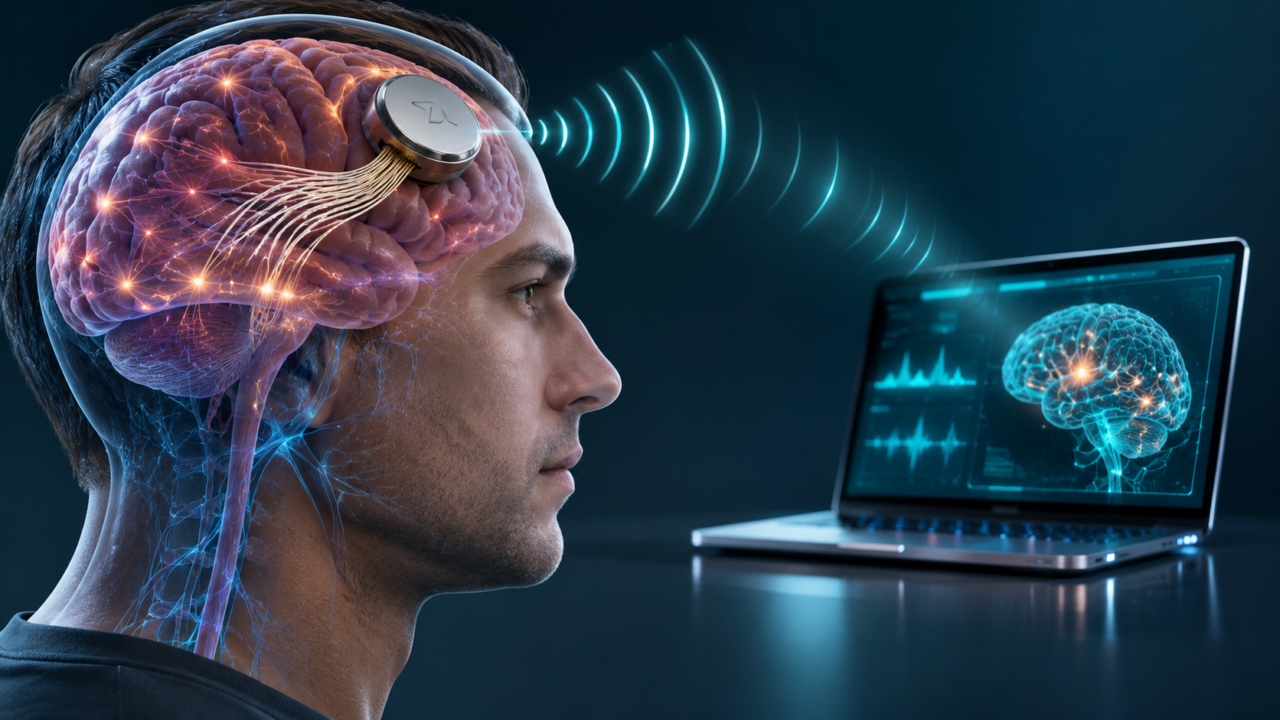
In March 2024, a man who cannot move his arms played online chess by thinking about moving a cursor. Noland Arbaugh, a quadriplegic since a 2016 diving accident, was the first person to receive a Neuralink implant, and his livestream showed cursor control and online chess. So how does a thought become a click? The answer starts long before Neuralink, with a bed of tiny silicon needles and a century of patient science.
What Is Neuralink?
Neuralink is a neurotechnology company founded in 2016 by Elon Musk and a team of scientists and engineers. A brain-computer interface (BCI) is a system that decodes intended movement signals from brain activity to control devices such as computers.
The Neuralink brain chip is the N1 implant. It is skull-mounted, wireless and rechargeable, and it records through 1,024 electrodes (tiny metal contacts that sense electricity) spread over 64 threads, each thinner than a human hair.
The goal is independence for people with severe paralysis. The PRIME study enrolls adults with quadriplegia caused by spinal cord injury or ALS (amyotrophic lateral sclerosis, a disease that destroys the nerve cells controlling muscles). The devices are investigational and not for sale.
Neuralink Did Not Invent Brain-Computer Interface Technology
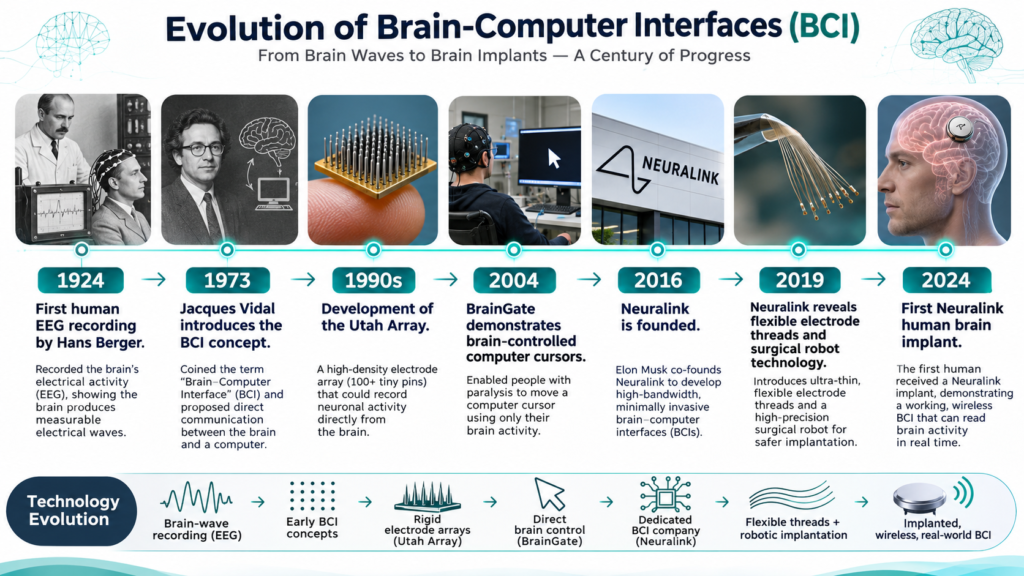
Neuralink builds on a century of work. Scientists note that monkeys moved cursors with neural signals as early as 2002, and that Neuralink’s real progress is engineering: wireless operation and more electrodes.
| Year | Milestone |
|---|---|
| 1924 | Hans Berger records the first human EEG (brain waves measured through the scalp) |
| 1969 | Eberhard Fetz shows a monkey can learn to control one neuron’s firing |
| 1973 | Jacques Vidal coins “brain-computer interface” (review) |
| 2004 | Matthew Nagle receives a Utah Array; he later moves a cursor by thought |
| 2023 | Stanford team decodes attempted speech at 62 words per minute |
| 2024 | Neuralink’s first human implant |
The Old Brain Implant: What Is the Utah Array?
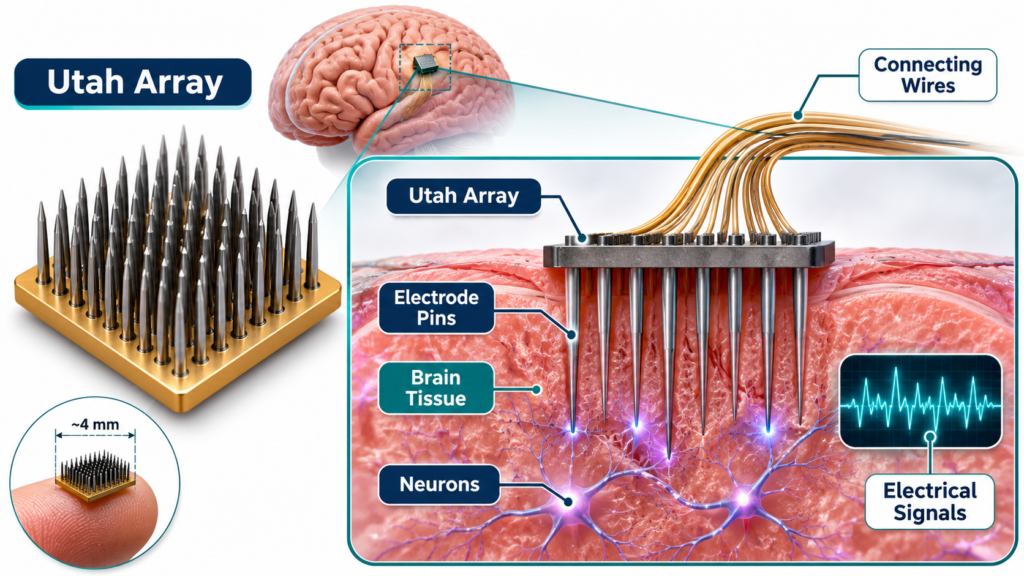
The Utah Array was developed by Richard Normann at the University of Utah. Picture a silicon square, 4 × 4 mm, about the size of a baby aspirin, with a 10 × 10 grid of needle-like pins. In the first human trial, 96 pins recorded signals, each about 1 mm long and spaced 400 micrometres apart. A pneumatic (air-powered) wand taps the array into the brain surface, usually the motor cortex, the region that plans movement.
Each pin picks up spikes, the brief electrical pulses neurons fire. Thin gold wires carry them to a titanium pedestal fixed to the skull, and a cable links the pedestal to external amplifiers and computers.
Why Rigid Pins Caused Trouble
Brain tissue is soft and always moving. Stiff probes can trigger immune responses that limit how long they work, and the fixed grid cannot steer around blood vessels. The brain’s support cells, called glia, can wall off foreign objects, separating electrodes from the neurons they should hear. Wires add risk as well: they raise the chance of device failure and clinical problems.
Utah Array vs Neuralink Flexible Threads
| Feature | Utah Array | Neuralink threads |
|---|---|---|
| Structure | Rigid silicon “needle bed” | Flexible polymer threads with gold traces |
| Electrodes | 96 recording pins, 1–1.5 mm long | 1,024 electrodes on 64 threads |
| Implantation | Air-powered wand, fixed grid | Robot places each thread, avoiding visible vessels |
| Connection | Classic: wires to a skull pedestal; wireless versions since 2022 | Fully implanted, wireless |
| Challenges | Stiffness mismatch, scarring, signal loss, skin irritation | Thread retraction, unproven long-term durability, heat |
[DIAGRAM 2 – Utah Array vs flexible threads]
Neuralink Side Effects and Early Challenges
It helps to separate three groups of problems.
Documented in people (Utah Array). A 2023 safety study followed 14 adults for 12,203 device-days. It found 68 device-related adverse events, 6 of them serious. The most common was skin irritation around the pedestal. There were no device removals, no brain infections and no permanent increase in disability. Two participants with earlier brain injuries had brief, treatable seizures.
Documented mainly in animals. In a monkey study, 62 of 78 arrays eventually failed completely, on average after 332 days, with scarring and insulation breakdown as major causes. Reviews describe signal decline, scarring and short disruptions that can drop performance to chance in 30 minutes. These are animal findings, not a forecast for every patient.
General surgical risks. Any brain surgery can involve bleeding, infection and reactions to anesthesia. These are risks of the procedure, not proof that a specific implant caused them.
How Neuralink Changed the Technology
Think of the Utah Array as a bed of nails and Neuralink’s threads as silk. Silk is gentler, but you cannot push it into tissue, so Neuralink built a robot to sew it in.
| Component | Job |
|---|---|
| Flexible threads | Sense neuron spikes; about 4–6 micrometres thick in the 2019 design |
| R1 robot | Threads a needle through a tiny loop on each thread; the 2019 robot placed six threads per minute |
| Custom chips | Amplify, digitize and pre-process tiny signals |
| Radio and charging coil | Send data wirelessly; charge without cables |
| N1 User App | Decodes movement intention into computer control |
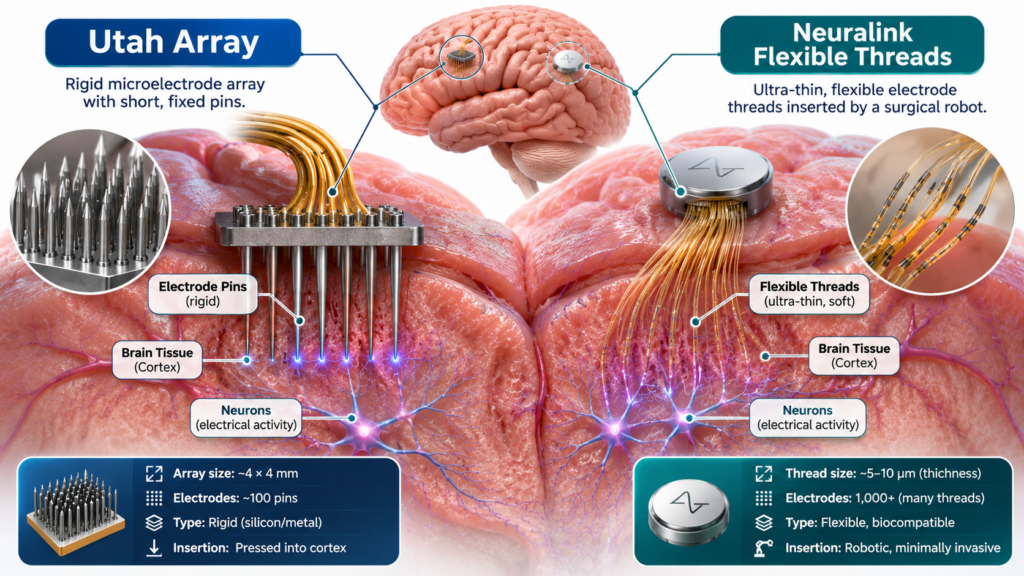
Flexibility lets threads move with soft tissue instead of fighting it. It does not remove scarring, bleeding or surgical risk, and independent long-term human data is still limited.
How Does Neuralink Work? Eight Steps
- Neurons (nerve cells that pass electrical messages) fire when you intend to move.
- Electrodes detect those signals.
- The implant amplifies and processes them.
- Data travels wirelessly to an external device.
- AI software looks for patterns in the activity.
- Algorithms decode trained movement intentions, such as “cursor up and left.”
- The decoded signal becomes a computer command.
- The user controls a compatible phone or computer.
[DIAGRAM 4 – Flowchart: Brain activity → Electrodes → Implant → Wireless transmission → AI decoding → Computer commands]
Each field has its own job. Neuroscience explains where intention appears in the motor cortex. Engineering builds hardware that captures it safely. AI acts as a translator, turning spike patterns that computers cannot naturally understand into commands, while the person imagines movements and the decoder learns the match.
Neuralink does not read every thought. It decodes trained intentions, such as attempted movement, not whatever a person happens to be thinking.
First Human Experiment: From Approval to Thread Problems
The FDA initially rejected Neuralink’s application in 2022, then approved the first trial in May 2023. The PRIME study began on 9 January 2024 at Barrow Neurological Institute in Phoenix. The registry lists 15 participants and a 2031 completion date.
On 8 May 2024, Neuralink disclosed that a number of threads had retracted from the brain, reducing effective electrodes and the cursor score, measured in bits per second (BPS), a mix of speed and accuracy. The company gave no clear cause, and the same report notes it posted after the Wall Street Journal asked questions. Software changes made the implant more sensitive, and the company said performance surpassed his starting level.
By 28 January 2026, Neuralink said 21 people were enrolled worldwide, with zero serious device-related adverse events. Both are company statements.
Three Engineering Challenges
1. Flexible Electrodes
Flexible electrodes were not new: Michigan researchers built them in 2004. The hard part is placing and keeping them. Established: stiffness mismatch is a known problem. Still unknown: how threads age over many years in people.
2. Wireless Data Transmission
Raw brain data is huge, so the implant detects spikes on-chip and sends compact data. The 2020 prototype used Bluetooth. Wireless removes the skin-piercing pedestal. Established: wireless BCIs work. Still unknown: bandwidth as channel counts climb.
3. Heat Management
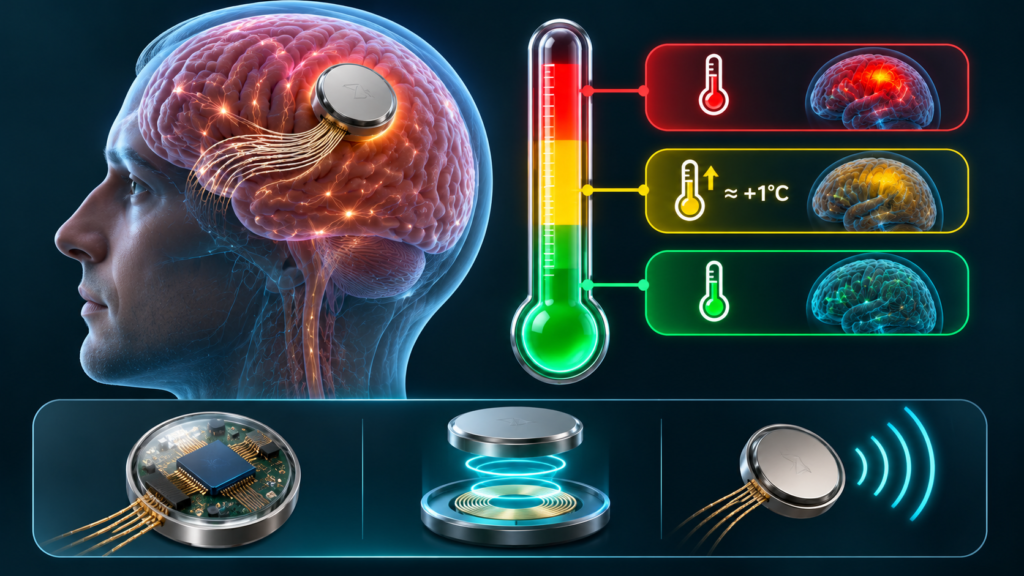
Chips that compute, transmit and charge make heat, and both temperature and exposure time matter for tissue. One standard says active implants should not heat surrounding tissue beyond 39°C, and researchers often aim for a rise under 1°C. Simulations of wireless implants find radio-exposure limits are reached well before a 1°C rise. Neuralink’s 2020 demo described a temperature sensor that disconnects the device if it overheats. Still unknown: long-term thermal effects with more channels.
Neuralink Human Trials: Latest Developments
- Scale: 21 participants officially (January 2026). Unofficial trackers count 27 or more; Neuralink has not published a newer total.
- Cursor control: On 1 October 2026, Neuralink said a participant reached 11.32 BPS, with a median near 10, using decoders pretrained on 50,000+ hours of data. This is a company claim, not independently reproduced.
- Physical devices: A robotic-arm trial called CONVOY was approved in 2024.
- Speech: Neuralink’s VOICE trial has shared videos of participants speaking through AI-rebuilt voices, but peer-reviewed accuracy data is unpublished. Independent Stanford work reached 62 words per minute.
- Vision: Blindsight earned an FDA Breakthrough Device designation in 2024, which is not approval. As of 2 November 2026, no study was listed on ClinicalTrials.gov.
- Next hardware: Musk said a next-generation implant with 3x capability is planned; this is a company claim.
Realistic near-term uses are communication, computer access and robotic-limb control for people with paralysis. All remain experimental, and one report says no peer-reviewed human data from Neuralink devices had appeared by October 2026.
Advantages, Limitations and Ethics
| Advantages | Limitations and risks |
|---|---|
| Computer control without hand movement | Brain surgery risks; long-term safety still being studied |
| Possible speech and communication help | Signal drift and device durability |
| Wireless, fully implanted design | Small trials, mostly company-reported results |
Privacy matters because these devices record brain activity. Open questions include who owns neural data, who can afford an implant, and who maintains it if a company changes course.
Conclusion
The Utah Array proved that neurons can move a cursor, but it was rigid, wired and short-lived in animal studies. Neuralink swaps the bed of nails for silk threads, adds a robot, and lets AI do the translating. The idea is old. The engineering is new. What remains unproven is the long haul: years of safe, stable use for many people. That answer will come from careful trials, not headlines.
Sources
- PRIME Study Brochure, Neuralink, undated. Link
- PRIME trial record NCT06429735, ClinicalTrials.gov, last updated January 2026. Link
- Neuronal ensemble control of prosthetic devices by a human with tetraplegia, Hochberg et al., Nature, 13 July 2006. Link
- Brain-computer interfaces used in first human BrainGate trial, ScienceDaily, 13 July 2006. Link
- Interim Safety Profile From the Feasibility Study of the BrainGate Neural Interface System, Rubin et al., Neurology, 14 March 2023. Link
- Failure mode analysis of silicon-based intracortical microelectrode arrays in non-human primates, Barrese et al., Journal of Neural Engineering, 12 November 2013. Link
- Classifying Intracortical Brain-Machine Interface Signal Disruptions, Frontiers in Neurorobotics, 2020. Link
- An Integrated Brain-Machine Interface Platform With Thousands of Channels, Musk and Neuralink, JMIR, 31 October 2019. Link
- Studies in RF Power Communication, SAR, and Temperature Elevation in Wireless Implantable Neural Interfaces, PLOS ONE, 6 November 2013. Link
- A high-performance speech neuroprosthesis, Willett et al., Nature, 23 August 2023. Link
- Brain-sensing threads slip from gray matter in first human Neuralink trial, The Register, 9 May 2024. Link
- Neuralink’s first brain chip implant developed a problem, CNN Wire via ABC7, 9 May 2024. Link
- Elon Musk’s Neuralink says it has 21 participants enrolled in trials, Reuters, 28 January 2026. Link
- Neuralink’s Blindsight Vision Implant Faces Questions Over Clinical Readiness, Drug Development & Delivery, November 2026. Link
- Musk’s Neuralink gets FDA’s breakthrough device tag for Blindsight, Reuters via ThePrint, September 2024. Link
- Connecting Minds and Devices: A Fifty-Year Review of Brain-Computer Interfaces, Chinese Journal of Electronics. Link
- An ALS patient set a record: 62 words per minute, MIT Technology Review, 24 January 2023. Link