Picture a royal party on a lake in the year 1206. Guests are relaxing, and a small boat floats by. On it, four mechanical musicians play drums, a harp and a flute, with no human touching them.
This was not a movie or a fantasy story. It was the work of a real engineer named Al-Jazari. Today, many people call him the “father of robotics.” In this post, you will learn who he was, how his machines worked, and whether he truly deserves that title.
Who Was Al-Jazari?
Al-Jazari’s full name was Badi’ al-Zaman Abu al-‘Izz Ismail ibn al-Razzaz al-Jazari. He lived from 1136 to 1206 in northern Mesopotamia (the land between the Tigris and Euphrates rivers, in today’s Turkey and Iraq region). metmuseum
He is believed to have served as chief engineer and adviser at the Artuklu Palace, home of the Mardin branch of the Artuqid dynasty. (Science Museum Group) Think of him as the royal family’s head of technology. sciencemuseumgroup
Here is a surprising fact: we know almost nothing about his personal life. The only biographical details we have come from the introduction of his own book. (Wikipedia) Wikipedia
His Famous Book: The Book of Knowledge of Ingenious Mechanical Devices
Al-Jazari’s biggest gift to the world is a book. In Arabic, it is called Kitab fi ma’rifat al-hiyal al-handasiyya, and it is also known simply as Automata. (An automaton is a machine that moves by itself, following a built-in mechanism.)
He wrote it while serving the Artuqid ruler of Diyarbakir, and finished it between 1204 and 1206. (Metropolitan Museum of Art) metmuseum
What makes the book special?
- It describes about 50 machines, and it gives instructions to build them.
- He explains that he only describes machines he built himself. Wikipedia
- The pages include detailed drawings, so later builders could follow along.
The machines fall into six groups: clocks, drinking-party vessels and figures, pitchers and basins, fountains and “perpetual flutes,” water-lifting machines, and a mixed group. metmuseum
Was Al-Jazari Really the “First Robot” Builder?
This is the question most people search for, so here is the honest answer: it depends on what you call a robot.
A robot in everyday talk is a machine that can do a task on its own. A programmable machine is one whose actions you can change without rebuilding it. Al-Jazari’s boat of musicians fits that idea in a very simple way, as you will see below.
Many writers give him the title. But robotics researcher Professor Noel Sharkey, who rebuilt the boat’s mechanism, is more careful. He believes al-Jazari’s work mattered for mechanics and, indirectly, for modern robotics, but he is not convinced the “father of robotics” label fits. He also says the musicians may not be the earliest programmable robot. (TechRadar) techradar
There is a reason for that caution. Al-Jazari was not working from zero. The most notable influence on him was a 9th-century book on water-powered automata by the Banu Musa brothers of Baghdad. And ancient Greek engineers such as Hero of Alexandria built self-moving machines far earlier. techradar
So the fair summary is this: Al-Jazari may not be the very first. But he is one of the best-documented early builders, and his clear instructions are why he is remembered.
How Did Al-Jazari’s Robot Band Work?
This is the most famous machine in the book, and its logic is surprisingly simple.
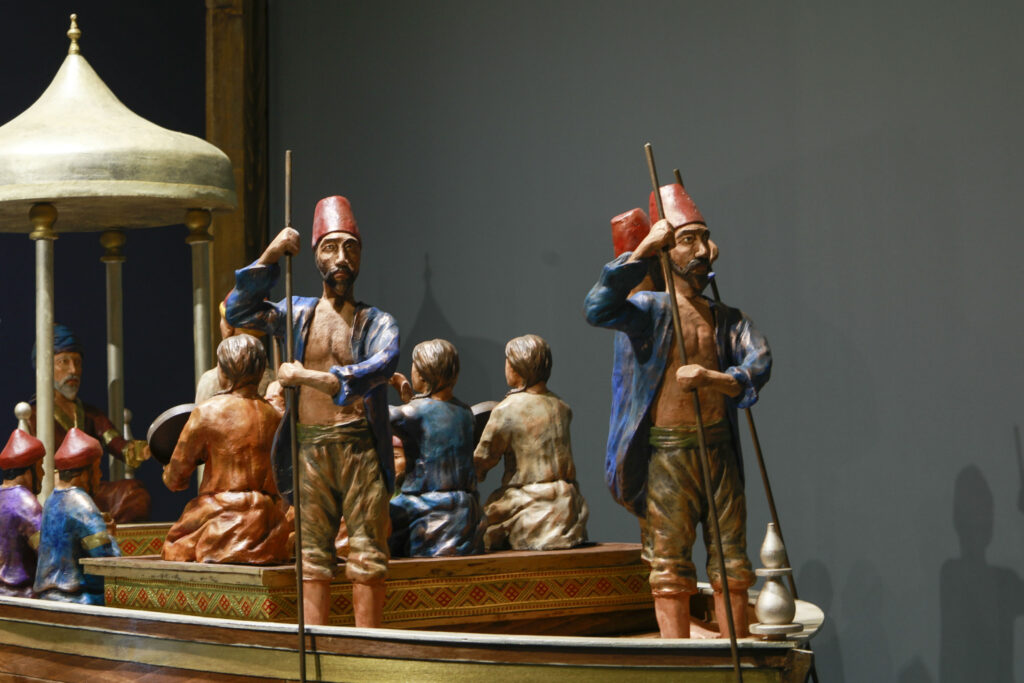
The setup: A boat floated on a lake carrying a four-piece band: two drummers, a harpist and a flute player, powered by water. (The Mad Museum) themadmuseum
The “brain”: A rotating drum, or cylinder, with small pegs fixed on it. As the drum turned, the pegs pushed against levers. Each lever made a musician’s arm move and hit an instrument.
The “program”: The position of the pegs decided the rhythm. As the pegs rotated, they pulled a lever that lifted the drummer’s arm, which then dropped onto the drum. The placement of the pegs fully controlled the beat and timing. (Al-Jazari Book blog) aljazaribook
In short, if you moved the pegs, you changed the music. That is why Sharkey and others see it as an early example of a programmable machine, a bit like a music box or a drum machine.
A quick term check: the pegs worked like a cam, a shaped part that turns round-and-round motion into back-and-forth motion. A camshaft is a rod that carries several cams. Al-Jazari used cams in his automata, water clocks and water-lifting machines. Wikipedia
One more thing to keep in mind: this was not artificial intelligence. The boat could not think or learn. It simply repeated whatever pattern was built into it. But the idea of changing a machine’s behavior by changing its settings is a distant ancestor of the code we write today.
The Elephant Clock: His Most Famous Invention
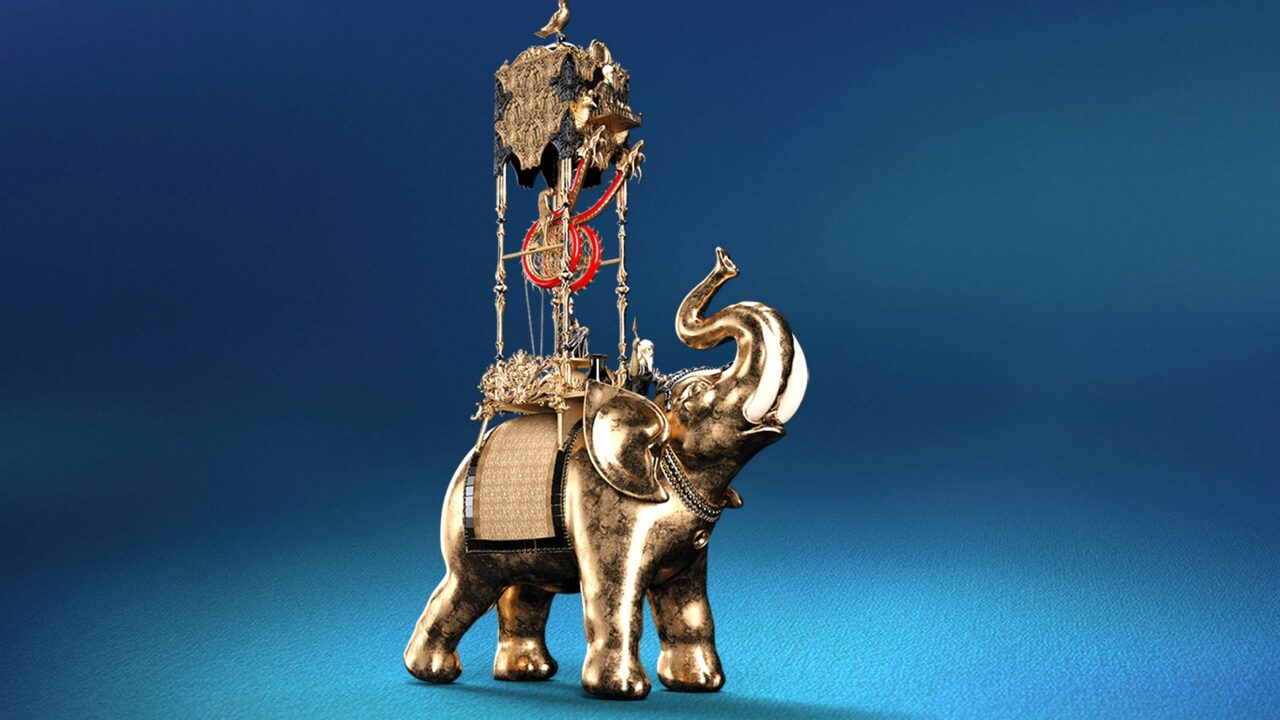
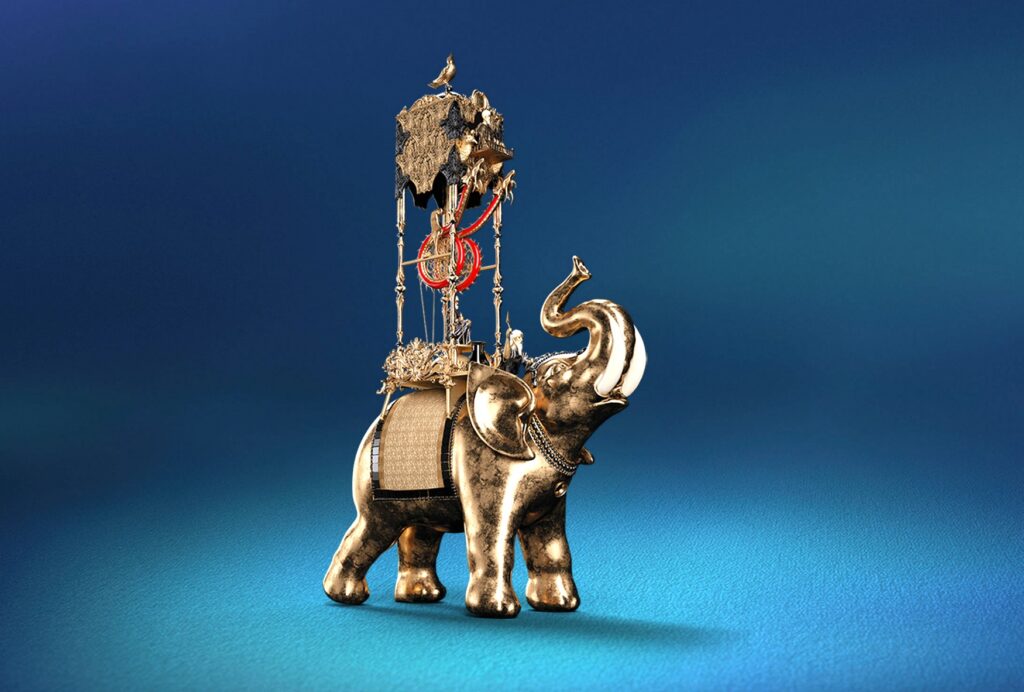
If you search for Al-Jazari’s pictures, you will almost always see the elephant clock. It is a giant water clock built in the shape of an elephant, with a rider, a scribe, a bird and two dragons.
A water clock measures time using the steady flow of water instead of gears and springs.
How it worked, step by step:
- Inside the elephant sat a hidden water tank. In it floated a deep bowl with a small hole in the middle. (Wikipedia: Elephant clock) Wikipedia
- Water slowly entered the bowl through that hole, so the bowl sank. A float is simply an object that sits on top of water, and here it worked like a timer.
- As the bowl sank, it pulled a string linked to a see-saw mechanism in the tower on the elephant’s back. Wikipedia
- When the bowl was fully sunk, the system tipped. A ball dropped, the figures moved, and sounds played. The clock used a cymbal strike by the elephant driver as part of this signal. (University of Bern) unibe
- The bowl was pulled back up, and the cycle began again.
The sinking time was tuned to roughly half an hour. According to a modern builder who studied the text, the sinking time was found by trial and error, and Al-Jazari did few calculations. (Al-Jazari Book blog) aljazaribook
That detail is worth remembering. Al-Jazari was a craftsman first. He built, tested and fixed his machines until they worked.
Other Amazing Machines He Built
The elephant clock and robot band are only part of the story.
- Hand-washing robot: One device was a peacock fountain with human-shaped figures that offered soap and towels. The story behind it is charming. A ruler disliked having a servant pour water on his hands, so a washing system was built instead. (Public Domain Review) sciencemuseumgrouppublicdomainreview
- Robot servers: Some figures served drinks from goblets, and others poured wine for each other. publicdomainreview
- Candle clocks: These told time as a candle burned down, with moving parts to show the hours.
- Water-lifting machines: He designed five machines for raising water. These helped bring water to fields and buildings. Wikipedia
- Early locks: He described a large metal door, a combination lock and a four-bolt lock. Wikipedia
- Crank-based pumps: He is often credited with early use of the crankshaft (a rotating shaft that turns circular motion into straight motion) in a machine. The simple hand crank was known earlier, so the credit is about how he used it.
Why Al-Jazari Still Matters Today
Why should a post on artificial intelligence care about a 12th-century engineer? There are three reasons.
1. He wrote everything down clearly. Many inventors of his time left no records. His book was copied many times, and it reads like a modern do-it-yourself guide. That is why engineers can rebuild his machines today. fandom
2. He showed that behavior can be set by design. Moving pegs to change a rhythm is a small version of what we do now with software. Every robot today follows instructions someone placed inside it.
3. He reminds us that technology has many roots. Writers have noted that school history often leaves out contributors like him, because of a Western-focused way of teaching. His story helps give a fuller picture of how robotics began. techradar
Frequently Asked Questions
Who is called the father of robotics?
Al-Jazari is the most common answer. Some experts, like Noel Sharkey, say the title is debatable, because earlier inventors also built automata.
Did Al-Jazari build the first robot?
He built one of the earliest well-documented programmable machines, the musical boat. Whether it is truly the “first” depends on your definition of a robot.
What is Al-Jazari’s most famous invention?
The elephant clock. It is also the most copied one in museums and modern models.
Was Al-Jazari’s robot a form of AI?
No. It had no ability to learn or decide. It followed a fixed mechanical pattern.
When did Al-Jazari live?
He lived from 1136 to 1206, and finished his famous book in the final years of his life.
Final Thoughts
Al-Jazari did not have electricity, computers or sensors. He had water, wood, metal, pegs and plenty of patience. With those, he built machines that moved, played music and told time on their own.
Whether or not he deserves the exact title “father of robotics,” his work is a fascinating step in the long story that leads to today’s robots and AI. Do you think the title fits him? Share your thoughts in the comments below.
Sources and Further Reading
- Ismail al-Jazari, Wikipedia
- Al-Jazari, Science Museum Group
- Folio from al-Jazari’s Book of Knowledge, Metropolitan Museum of Art
- Ismail al-Jazari’s Ingenious Mechanical Devices, The Public Domain Review
- The forgotten history of the 800-year-old robot, TechRadar
- Medieval robots? They were just one of this Muslim inventor’s creations, National Geographic
- Elephant clock, Wikipedia
- The Elephant Clock, University of Bern
- The Musical Boat for a Drinking Party, Al-Jazari Book blog
- Automata during the Middle Ages, The Mad Museum